I couldn't find where to learn about applying systems thinking to building products, so I built it.
IF YOU'VE EVER FELT like...
- design is more than just drawing boxes and nitpicking over pixels
- the answer to confusing navigation isn't just a new layout
- something is off in a design, but you're not quite sure what
- you're designing screens rather than products
- you've seen “systems thinker” in a job description but you're not totally sure what it means
Then you're in the right place.
SIMPLY Making better pixels ISn'T THE LEVEL-UP WE WANT
I'm Dave Connis and I've been in product design for over ten years. The further I got in my career, the HANGRIER I got for deeper product thinking. Not "which button is better," Figma tutorials, or how to have influence, something that truly helped me design better products in my day-to-day.
I found a few things that scratched the itch, but they were typically one of, or all of, these things:
- academic and boring
- expensive
- stuffy and pretentious
- unrealistic for lean product orgs
- lived in theoretical space
After getting frustrated with my options, I decided to build System Design Lab and distill all that I'd learned from a UX career building developer-focused tools.
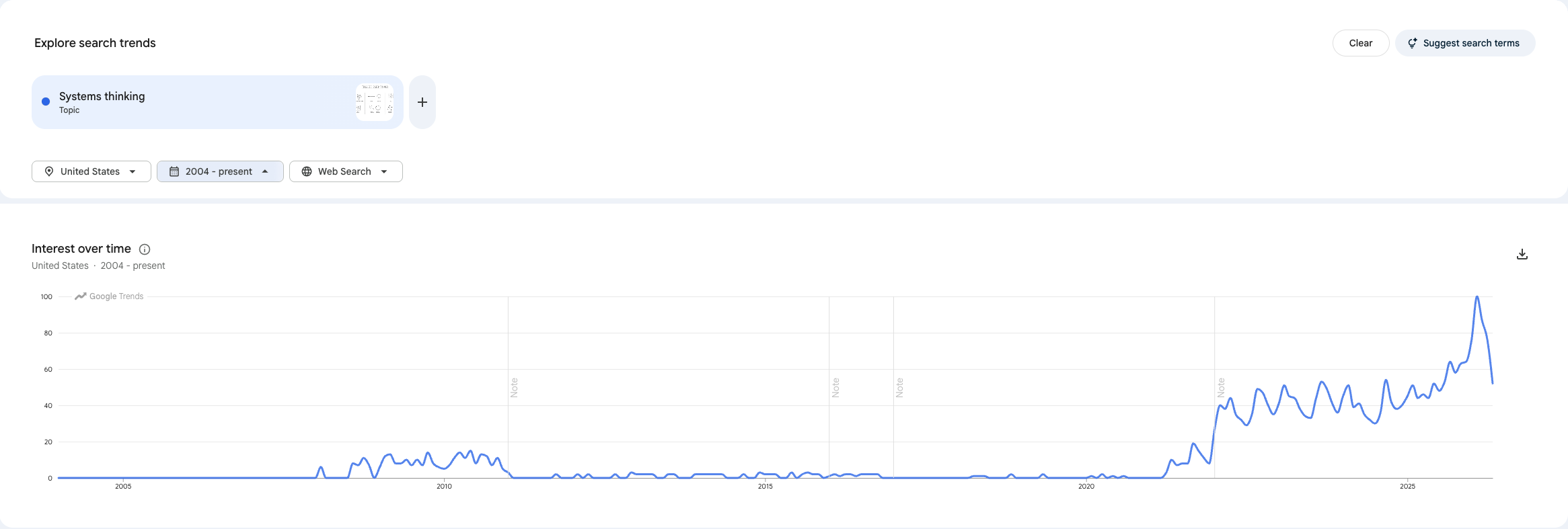
AI has changed how we design, and while it was always needed, the need for systems thinking skills has changed with it. With the rise of AI, it's grown increasingly obvious that design is shifting away from the things that can be generated, colors, components, etc, and more towards how things connect, how the things in a product work together and relate across surfaces. Companies are specifically calling this out in job postings. You can see the rise in a simple Google Trends search.
System Design Lab is here to fill that gap, and we have a few principles that drive what we do.
200+ designers
I've trained over 200+ designers in systems thinking principles
50+ countries
Over 50+ countries have learned systems thinking from my workshops
Accessible & rewatchable
Systems thinking is a superpower but it's not one you learn in a 4 week cohort. It takes practice and steeping in the ideas and concepts.
The biggest thing I've learned teaching systems thinking for product design is that you need to be exposed to its ideas over and over and over for things to start clicking. That's why system design lab courses aren't locked behind a single cohort in time, but accessible for as long as you're a member. We built it not just for learning, but for continual reference.
human-centered, on purpose
Anyone can ask AI to write a course, but one of my principles for System Design Lab was not just to teach complicated things simply, but to tell a story, and tell it human-first. So much of the system discussion right now centers around AI, but ultimately we build for humans. This means I write all the content myself. I record the videos to be fun and engaging, not polished and perfect. This means imperfection by design, not stuffy "I know everything, bow to me" takes.
The mission
Everyone is talking about the change in how products are designed and built. I believe that systems thinking is more crucial now than ever and that it is the only way forward for designers and builders who need to design apps that make sense.
AI loves to create everything you ask, but, ultimately it's you who needs to keep track of how it all connects. Becoming a designer and builder who knows how the system underneath the UI, who knows how to be a product architect, is no longer optional.
I've put heart into system design lab to make it the most accessible, practical, and reusable systems thinking content out there. Something you can reach for when the problem you're looking at doesn't have an obvious shape yet. AI can only get you so far and you'll be left wondering why things still feel off.
But once you know the system, it doesn't matter how things are designed and created, AI, prompt, wireframes, you can always create things that make sense.
— Dave Connis, founder of System Design Lab
READY TO THINK IN SYSTEMS?